

A Narrow Body Of Water
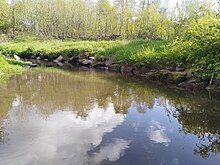
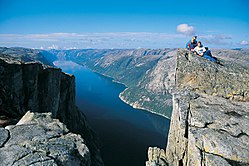
A body of water or waterbody [i] (often spelled water body) is whatever significant accumulation of h2o on the surface of Earth or another planet. The term most often refers to oceans, seas, and lakes, but it includes smaller pools of water such as ponds, wetlands, or more than rarely, puddles. A body of water does not have to exist withal or contained; rivers, streams, canals, and other geographical features where h2o moves from one identify to another are also considered bodies of h2o.[2]
Most are naturally occurring geographical features, simply some are artificial. There are types that tin can be either. For instance, most reservoirs are created past engineering dams, just some natural lakes are used as reservoirs. Similarly, almost harbors are naturally occurring bays, but some harbors have been created through construction.
Bodies of water that are navigable are known as waterways. Some bodies of h2o collect and motility water, such as rivers and streams, and others primarily hold water, such as lakes and oceans.
Bodies of water are affected by gravity, which is what creates the tidal furnishings on Earth.[3]
Types [edit]

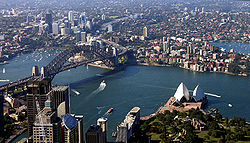


A weir in Toledo, Spain. Weirs are oftentimes used to modify the height of a riverlevel, prevent floodings, and measure water discharge.
Note that there are some geographical features involving water that are non bodies of water, for case, waterfalls, geysers and rapids.
- Arm of the sea – also body of water arm, used to draw a sea loch.
- Arroyo – (southwest US) (seasonal) a commonly-dry out bed of a steep-sided stream, gully, or narrow channel that temporarily fills with h2o after heavy pelting. See also wadi.
- Artificial lake or artificial pond – see reservoir (impoundment).
- Aubach
- Barachois – (Canada) a lagoon separated from the ocean by a sand bar.
- Basin
- Bay – an area of water bordered past land on 3 sides, similar to, only smaller than a gulf.
- Bayou – (southern Us) a slow-moving stream or a marshy lake.
- Brook – (Great britain) a small stream (esp. with a rocky bottom); creek.[4]
- Bight – a big and often simply slightly receding bay, or a bend in any geographical feature.
- Billabong – an oxbow lake in Commonwealth of australia; a pond or however trunk of water created when a river changes course and some water becomes trapped.
- Boil – meet seep
- Bog – a blazon of wetland that accumulates peat due to incomplete decomposition of plant matter.
- Bourn – a brook; stream; small, seasonal stream.[five] [6]
- Beck – a small stream; a creek.[7]
- Brooklet – a small brook.
- Fire – (Scottish) a minor stream; a brook.[8] [nine]
- Canal – an artificial waterway, unremarkably continued to (and sometimes connecting) existing lakes, rivers, or oceans.
- Channel – the physical confine of a river, slough or ocean strait consisting of a bed and banks. See too stream bed and strait.
- Cove – a littoral landform. Earth scientists mostly utilise the term to describe a circular or round inlet with a narrow entrance, though colloquially the term is sometimes used to draw any sheltered bay.
- Creek – (Australia, Canada, New Zealand, United States) a (narrow) stream that is smaller than a river; a pocket-sized tributary of a river; brook.[xv]
- Creek (tidal) – (mainly British) an inlet of the body of water, narrower than a cove.[20]
- Delta – the location where a river flows into an bounding main, sea, estuary, lake, or reservoir.
- Distributary or distributary channel – a stream that branches off and flows away from the principal stream channel.
- Drainage bowl – a region of state where water from rain or snowmelt drains downhill into another trunk of water, such as a river, lake, or reservoir.
- Draw – a usually dry out creek bed or gulch that temporarily fills with h2o after a heavy pelting, or seasonally. See also wadi.
- Estuary – a semi-enclosed coastal bounding main with one or more rivers or streams flowing into it, and with a free connection to the open sea
- Firth – (Scottish) various coastal waters, such equally large sea bays, estuaries, inlets, and straits.
- Fjord (fiord) – a narrow inlet of the sea between cliffs or steep slopes.[21]
- Gill – (UK) a narrow stream or rivulet; brook; narrow mountain stream.[25]
- Glacier – a large collection of ice or a frozen river that moves slowly downwards a mount.
- Glacial pothole – a giant's kettle.
- Gulf – a part of a lake or ocean that extends then that information technology is surrounded by land on three sides, similar to, but larger than a bay.
- Harbor – an artificial or naturally occurring body of h2o where ships are stored or may shelter from the ocean's weather and currents.
- Hot jump – a spring produced by the emergence of geothermally heated groundwater.
- Impoundment – an artificially-created body of water, by damming a source. Often used for inundation command, as a drinking water supply (reservoir), recreation, ornamentation (bogus swimming), or other purpose or combination of purposes. Annotation that the process of creating an "impoundment" of water is itself called "impoundment."
- Inlet – a bounding main, usually seawater, which has characteristics of one or more of the following: bay, cove, estuary, firth, fjord, geo, body of water loch, or sound.
- Kettle (or kettle lake) – a shallow, sediment-filled body of water formed by retreating glaciers or draining floodwaters.
- Kill – used in areas of Dutch influence in New York, New Jersey and other areas of the former New Netherland colony of Dutch America to depict a strait, river, or arm of the sea.
- Lagoon – a trunk of comparatively shallow salt or brackish water separated from the deeper sea by a shallow or exposed sandbank, coral reef, or similar feature.
- Lake – a torso of h2o, usually freshwater, of relatively large size contained on a body of country.
- Lick — a small watercourse or an ephemeral stream
- Loch – (Scottish) a body of water such as a lake, bounding main inlet, firth, fjord, estuary or bay.
- Mangrove swamp – a saline littoral habitat of mangrove trees and shrubs.
- Marsh – a wetland featuring grasses, rushes, reeds, typhas, sedges, and other herbaceous plants (perhaps with low-growing woody plants) in a context of shallow water. See besides salt marsh.
- Mediterranean sea (oceanography) – a mostly enclosed sea that has a limited exchange of deep water with outer oceans and where the h2o circulation is dominated by salinity and temperature differences rather than winds
- Mere – a lake or bounding main that is broad in relation to its depth.
- Mill pond – a reservoir built to provide flowing h2o to a watermill.
- Moat – a deep, broad trench, either dry out or filled with h2o, surrounding and protecting a construction, installation, or town.
- Mud puddle
- Bounding main – a major body of salty water that, in totality, covers nigh 71% of the Earth's surface.
- Oxbow lake – a U-shaped lake formed when a wide meander from the mainstem of a river is cutting off to create a lake.
- Phytotelma – a small, detached body of water held by some plants.
- Plunge pool – a low at the base of a waterfall.
- Pool – diverse small bodies of h2o such as a pond pool, reflecting puddle, pond, or puddle.
- Pond – a body of water smaller than a lake, especially those of artificial origin.
- Port – a maritime facility where ships may dock to load and belch passengers and cargo.
- Pothole – see kettle
- Pool – a small accumulation of water on a surface, usually the ground.
- Reflecting pool – a water feature normally consisting of a shallow pool of water, undisturbed by fountain jets, for a cogitating surface.
- Reservoir – a place to shop water for diverse uses, especially drinking h2o, which can exist a natural or artificial (run across lake and impoundment).
- Rill – a shallow channel of running water. These can be either natural or human-made. Too: a very small brook; rivulet; small stream.[26] [27]
- River – a natural waterway usually formed by h2o derived from either precipitation or glacial meltwater, and flows from college ground to lower ground.
- Rivulet – (Uk, US literary) a small or very small stream.[28]
- Roadstead – a place exterior a harbor where a ship can prevarication at anchor; it is an enclosed area with an opening to the sea, narrower than a bay or gulf (often called a "roads").
- Run – a small stream or part thereof, especially a smoothly flowing part of a stream.
- Salt marsh – a type of marsh that is a transitional zone betwixt land and an surface area, such as a slough, bay, or estuary, with salty or brackish water.
- Bounding main – a large area of saline water connected with an ocean, or a big, usually saline, lake that lacks a natural outlet such as the Caspian Sea and the Expressionless Sea. In common usage, ofttimes synonymous with the sea.
- Ocean loch – a bounding main inlet loch.
- Body of water lough – a fjord, estuary, bay or sea inlet.
- Seep – a bounding main formed by a spring.
- Slough – several different meanings related to wetland or aquatic features.
- Source – the original signal from which the river or stream flows. A river's source is sometimes a jump.
- Shoal – a natural submerged ridge, bank, or bar that consists of, or is covered by, sand or other unconsolidated material, and rises from the bed of a body of water to well-nigh the surface.
- Sound – a large bounding main or sea inlet larger than a bay, deeper than a bight, wider than a fjord, or it may identify a narrow sea or ocean channel betwixt two bodies of land.
- Jump – a point where groundwater flows out of the ground, and is thus where the aquifer surface meets the ground surface
- Strait – a narrow channel of water that connects two larger bodies of water, and thus lies betwixt two land masses.
- Stream – a body of water with a detectable current, bars within a bed and banks.
- Stream pool – a stretch of a river or stream in which the h2o is relatively deep and wearisome moving.
- Streamlet — a small stream; rivulet.[29]
- Subglacial lake – a lake that is permanently covered by ice and whose water remains liquid by the pressure of the ice sail and geothermal heating. They frequently occur nether glaciers or ice caps. Lake Vostok in Antarctica is an example.
- Swamp – a wetland that features permanent overflowing of large areas of land by shallow bodies of h2o, more often than not with a substantial number of hummocks, or dry out-country protrusions.
- Swimming pool – an artificial container filled with water intended for pond.
- Tank – (or stock tank, Texas) an artificial swimming, usually for watering cattle or other livestock.[xxx]
- Tarn – a mountain lake or pool formed in a cirque excavated past a glacier.
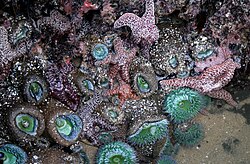
- Tide puddle – a rocky pool side by side to an bounding main and filled with seawater.
- Tributary or affluent – a stream or river that flows into the chief stem (or parent) river or a lake.
- Vernal pool – a shallow, natural depression in level footing, with no permanent above-ground outlet, that holds water seasonally.
- Wadi – a usually-dry creek bed or gulch that temporarily fills with h2o after a heavy rain, or seasonally; located in North Africa and Western Asia. Encounter also arroyo (creek).
- Wash – a usually dry out creek bed or gulch that temporarily fills with water after a heavy rain, or seasonally. See also wadi.
- Wetland – an environs "at the interface between truly terrestrial ecosystems and truly aquatic systems making them unlike from each nevertheless highly dependent on both".[31]
See also [edit]
- Bog – Type of wetland that accumulates peat due to incomplete decomposition of plant matter
- Fluvial processes – Processes associated with rivers and streams
- Lists of bodies of water
- Port – Maritime facility where ships may dock to load and discharge passengers and cargo
- Banking concern (geography) – Land alongside a body of water
- Water mass – Body of water with common germination history
- H2o pollution – Contamination of water bodies
- Glossary of landforms
References [edit]
Sources [edit]
- Mitsch, West.J. and J.Grand. Gosselink. 2007. Wetlands, 4th ed., John Wiley & Sons, Inc., New York, 582 pp.[32]
Citations [edit]
- ^ "waterbody noun (pl. -ies) a body of water forming a physiographical feature, for example a sea or a reservoir." New Oxford Dictionary of English
- ^ Langbein, Westward.B.; Iseri, Kathleen T. (1995). "Hydrologic Definitions: Stream". Manual of Hydrology: Role 1. General Surface-Water Techniques (Water Supply Paper 1541-A). Reston, VA: USGS. .
- ^ "What causes high tide and low tide? Why are there two tides each day?". HowStuffWorks. 21 May 2009. Retrieved ten December 2017.
- ^ "beck". collinsdictionary.com. Collins. Retrieved 16 May 2019.
- ^ "bourn". collinsdictionary.com. Collins. Retrieved xvi May 2019.
- ^ "bourn". oxforddictionaries.com. Oxford University Press. Archived from the original on September thirty, 2016. Retrieved 16 May 2019.
- ^ "brook". merriam-webster.com. Merriam-Webster, Incorporated. Retrieved 16 May 2019.
- ^ "burn down". collinsdictionary.com. Collins. Retrieved xvi May 2019.
- ^ "burn". oxforddictionaries.com. Oxford Academy Printing. Archived from the original on November 5, 2018. Retrieved sixteen May 2019.
- ^ "creek". oxforddictionaries.com. Oxford University Printing. Archived from the original on September 24, 2016. Retrieved 18 May 2019.
British...specially an inlet...(whereas) NZ, North American, Australian...stream or small-scale tributary.
- ^ "(US) creek". English Oxford Living Dictionaries. Oxford University Press. Archived from the original on September 24, 2016. Retrieved 18 May 2019.
North American, Australian, NZ...A stream, beck, or minor tributary of a river.
- ^ "creek". Dictionary.com. Dictionary.com, LLC. Retrieved 18 May 2019.
U.Due south., Canada , and Australia…a stream smaller than a river.
- ^ "creek". Collins. Collins. Retrieved 18 May 2019.
US, Canadian, Australian and New Zealand a small-scale stream or tributary
- ^ "creek". Macmillan Dictionary. Springer Nature Limited. Retrieved xviii May 2019.
a narrow stream
- ^ [10] [11] [12] [13] [14]
- ^ "creek". oxforddictionaries.com. Oxford University Press. Archived from the original on September 24, 2016. Retrieved eighteen May 2019.
British...particularly an inlet
- ^ "creek". Dictionary.com. Lexicon.com, LLC. Retrieved 18 May 2019.
Chiefly Atlantic States and British...a recess or inlet in the shore of the ocean.
- ^ "creek". Macmillan Dictionary. Springer Nature Express. Retrieved 18 May 2019.
BRITISH a long narrow area of ocean stretching into the land
- ^ "creek". Collins. Collins. Retrieved eighteen May 2019.
Importantly British a narrow inlet or bay
- ^ [sixteen] [17] [18] [19]
- ^ "Definition of FJORD". www.merriam-webster.com . Retrieved xv June 2017.
- ^ "gill". merriam-webster.com. Merriam-Webster, Incorporated. Retrieved 16 May 2019.
- ^ "gill". collinsdictionary.com. Collins. Retrieved 16 May 2019.
- ^ "gill". oxforddictionaries.com. Oxford University Press. Archived from the original on September 27, 2016. Retrieved 16 May 2019.
- ^ [22] [23] [24]
- ^ "rill". collinsdictionary.com. Collins. Retrieved 16 May 2019.
- ^ "rill". oxforddictionaries.com. Oxford Academy Press. Archived from the original on May 17, 2019. Retrieved 16 May 2019.
- ^ "rivulet". dictionary.cambridge.org. Cambridge University Press. Retrieved 16 May 2019.
- ^ "streamlet". collinsdictionary.com. Collins. Retrieved 16 May 2019.
- ^ "Texas Primer: The Stock Tank". Texas Monthly. 1986-05-01. Retrieved 2021-08-03 .
- ^ Mitsch & Gosselink, 1986
- ^ The starting time edition of Wetlands by Mitsch and Gosselink was published in 1986 by Van Nostrand Reinhold. 2d, 3rd, and fourth (electric current) editions were published in 1993, 2000, and 2007 respectively by John Wiley & Sons. "Wiley: Wetlands, 4th Edition". Archived from the original on 3 July 2012. Retrieved 10 July 2012.
External links [edit]
- Types of H2o Bodies

A Narrow Body Of Water,
Source: https://en.wikipedia.org/wiki/Body_of_water
Posted by: williamscoatseardeas.blogspot.com
0 Response to "A Narrow Body Of Water"
Post a Comment